
"TechCarbide™" Tungsten Carbide Rods Product Line
"TechCarbide™" Tungsten Carbide Rods Product Line
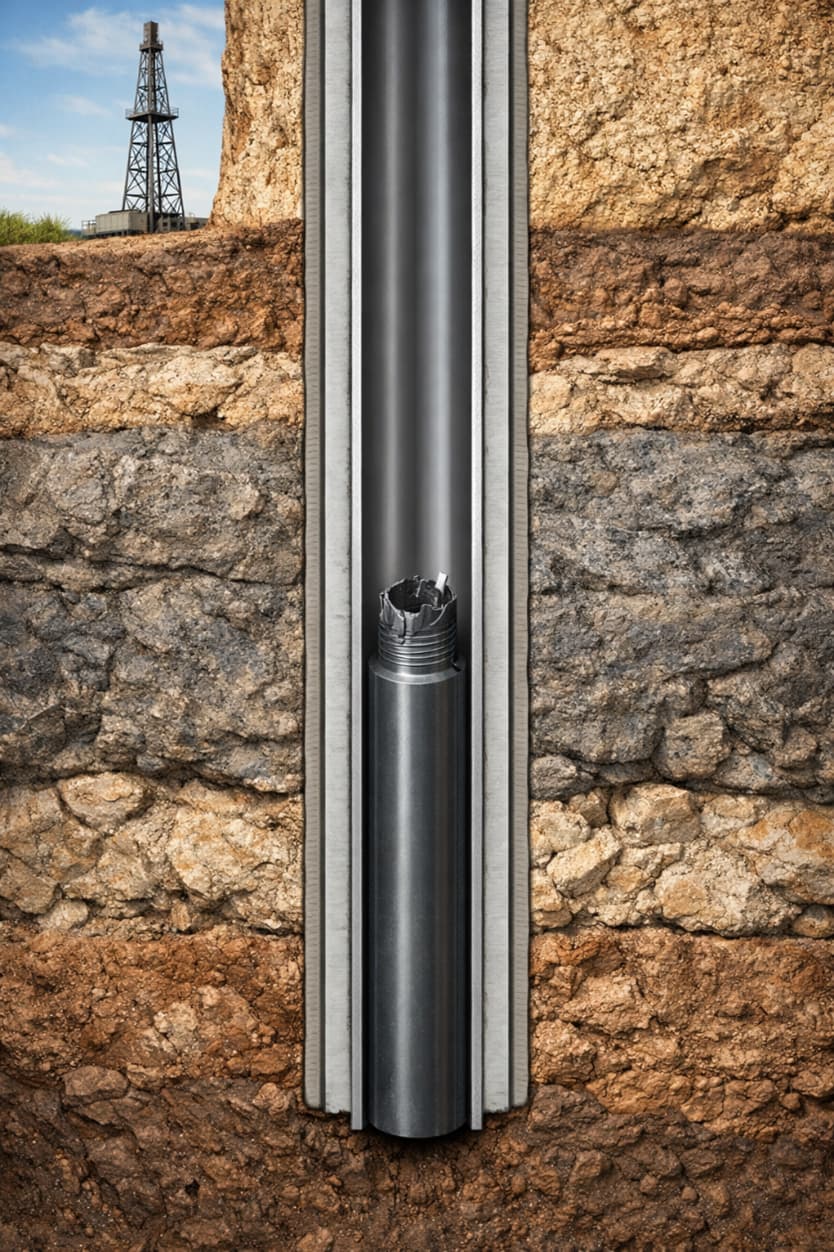
Fishing and Remedial Operations — One of the Most Significant Factors in Drilling Time and Cost.
When a stuck pipe, twist-off occurs, or a fish is left in the wellbore, drilling ceases to be a "planned interval progression" and shifts into the mode of fishing and remedial operations: fishing runs, milling for catch, junk clean-out, and repeated tripping cycles. That is why their role in the project is disproportionately large: a industry report by the British regulator explicitly states that non-productive time still exceeds 15%, meaning that even under managed conditions, a noticeable portion of the calendar regularly "burns up" on unplanned operations.
In complex geological and organizational conditions, the scale becomes even more tangible: field analyses show that non-productive time can approach one-third of the total drilling time, with stuck pipes and associated fishing operations systematically appearing among the key causes. This immediately translates into money because the logic is simple: non-productive time is directly proportional to drilling costs — each additional day of emergency mode multiplies expenditures not only due to the daily rig rate but also through auxiliary services, personnel downtime, logistics, and tool wear; industry assessments provide a benchmark that on average, about 22% of the drilling budget can be attributed to non-productive time associated with wellbore problems, where fishing and remedial operations are concentrated.
Fishing and Remedial Operations: Where the Money Really "Burns" and Why Tungsten Carbide is the Answer
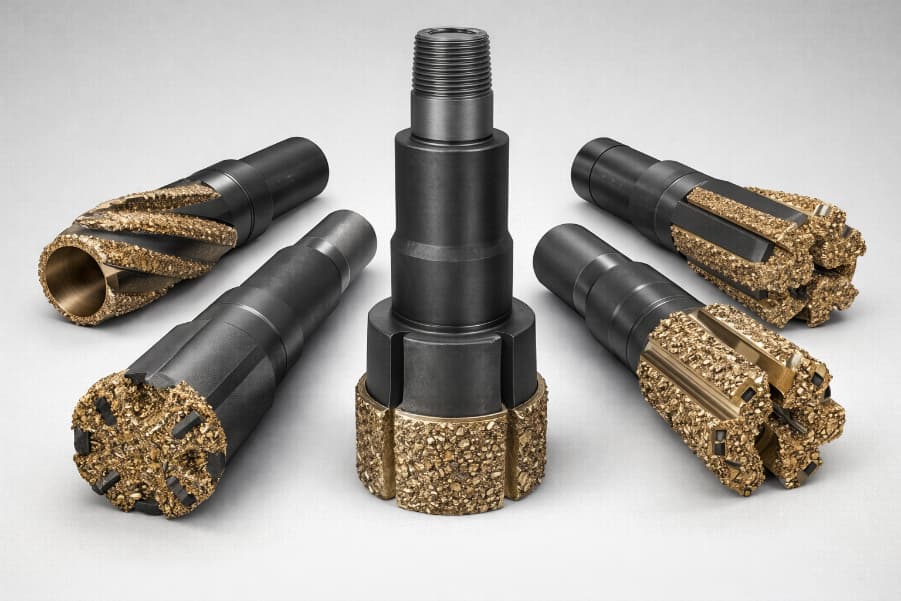 Fishing and remedial operations are not a single
action, but a sequence of interconnected operations: stuck pipe mitigation (working the pipe, jar operations) → fishing operations
(catching and retrieving the fish) → milling/washover (preparing the "fish neck" for catch or removing an obstruction) → cleaning
the wellbore bottom from shavings and debris. The critical moment is that a significant part of the emergency time "burns" not on
the catch itself, but on preparation and handling the consequences — deformations, burrs, shavings, and debris. This is exactly where the
tool works against metal and cement sheath, and wear ceases to be just "materials science": if the cutting and contact surfaces
rapidly lose functionality, the remedial operation turns into a series of lengthy repetitions with tripping and reworking what has already been done.
Fishing and remedial operations are not a single
action, but a sequence of interconnected operations: stuck pipe mitigation (working the pipe, jar operations) → fishing operations
(catching and retrieving the fish) → milling/washover (preparing the "fish neck" for catch or removing an obstruction) → cleaning
the wellbore bottom from shavings and debris. The critical moment is that a significant part of the emergency time "burns" not on
the catch itself, but on preparation and handling the consequences — deformations, burrs, shavings, and debris. This is exactly where the
tool works against metal and cement sheath, and wear ceases to be just "materials science": if the cutting and contact surfaces
rapidly lose functionality, the remedial operation turns into a series of lengthy repetitions with tripping and reworking what has already been done.
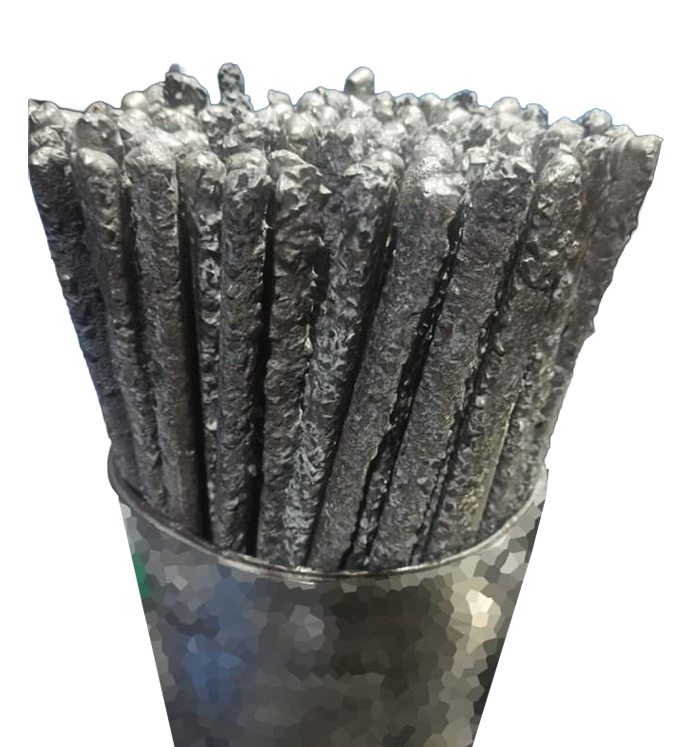
That is why in fishing and remedial operations, tungsten carbide-based hard-facing fillers are inevitable. Remedial tools — junk mills, casing and washover shoes, BHA elements in contact with the wellbore wall — operate in a regime where abrasives, impacts, contact friction, and uneven loads are simultaneously present. In such a combination, conventional steels "burn through" their service life too quickly: either the aggressiveness of the parameters must be increased (thereby risking complications), or the tool must be replaced more frequently (wasting time). A tungsten carbide-based matrix composite hard-facing filler (WC-Co) in these applications is a practical way to anchor the cutting and abrasive capability of the working surfaces and make the service life predictable. At the rig site, "datasheet hardness and figures" do not matter as much as the applied result: how long the tool maintains its edge/bond, how it withstands impacts, and how evenly it wears without losing its function.
TechCarbide Hard-Facing Rods with WC-Co: A Controlled Layer for Cutting and Abrasives.
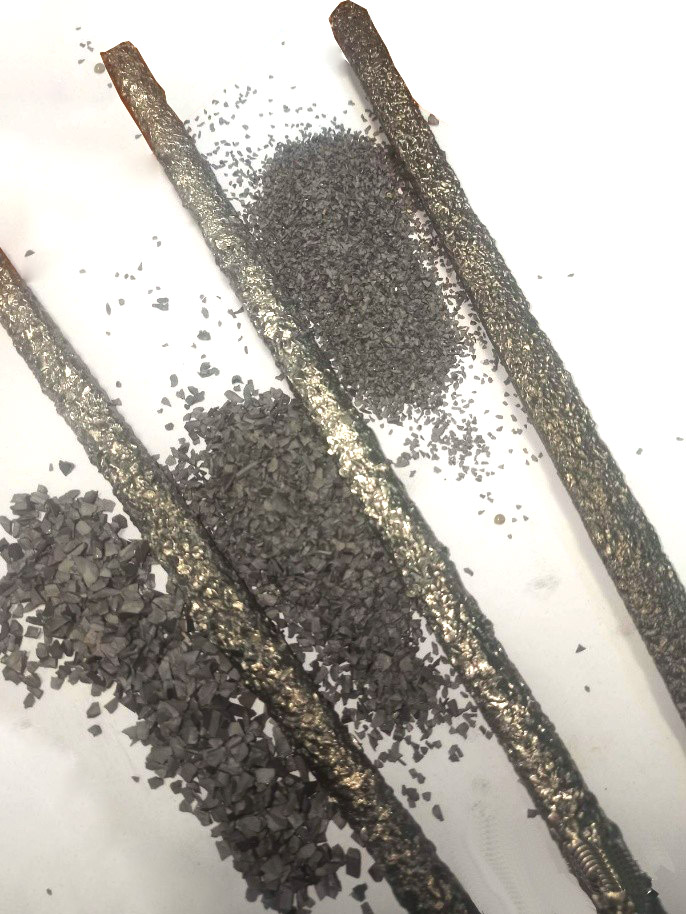
Tungsten carbide material on its own does not "work" until it is secured within a metallic matrix on the working surface. In field repair and remedial tool manufacturing, this task is typically solved by hard-facing: a layer is formed on the working zones that simultaneously retains the WC-Co grain under abrasive and impact loads, provides the required "aggressiveness" (cutting/abrasion), and does not degrade from the thermal cycle and dilution by the base metal.
This is precisely where TechCarbide hard-facing rods become the key "vehicle" of the technology. They ensure controlled carbide introduction (content, grain type, fraction) and controlled operation of the matrix (bond), as well as repeatability during repairs — when there is no time for complex preparatory operations and "manual recipes."
To make the selection of a TechCarbide rod practical and reproducible, we align it with our classification system — in the form of three components:
- Series / Matrix — defines the type of metallic bond and how the layer retains WC-Co and withstands the thermal cycle.
- WC-Co Filler — specifies the carbide part: grit (type and fraction) or shaped inserts (type and size), which determines the cutting/abrasion level and the nature of wear.
- TechCarbide Rod Type — establishes the format (mono-composition or mixture), required modifications (if needed), and the presence/absence of flux; this accounts for repair repeatability and the risk of repeated runs.
These three parameters are directly related to what costs the most in fishing and remedial operations: cycle time and the risk of repeated runs. The more stably the hard-faced layer maintains its function, the fewer repeated runs, fewer tool changes, and the faster the return to planned operations.
TechCarbide Rod Selection is Conducted According to the Classification
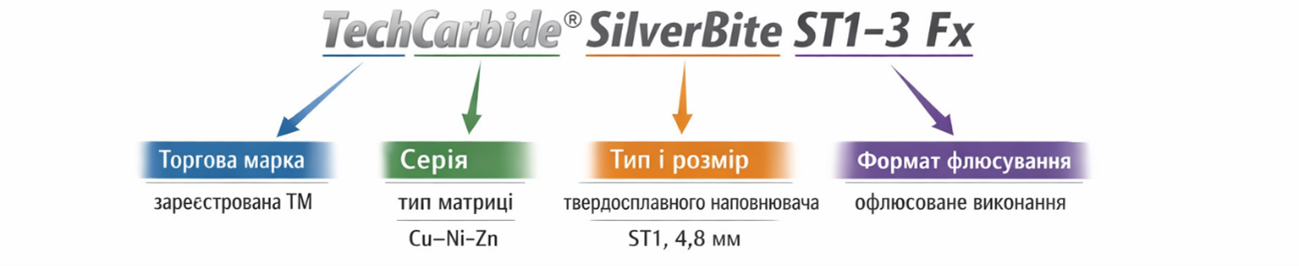
The selection of a TechCarbide hard-facing rod with WC–Co is performed using a classification system that fixes three key parameters: series (matrix type), type and size of the carbide filler, and the fluxing format.
Thus, the selection is made not "generally for the rod," but for a specific task: the material of the interval, the tool operating mode, the required cutting profile, and the layer service life requirements.
Selecting a TechCarbide Rod by Series (Matrix)
The first step in selecting a TechCarbide hard-facing rod with a WC–Co carbide filler is choosing the series, which means the type of metallic matrix that will retain the grain and determine the layer behavior. Essentially, this answers three questions: what base metal and thermal regime are permissible, what is the operating nature of the zone (cutting/abrasion/erosion/corrosion), and what application method is practically available during repair.
| Matrix (Type) | Product Series | Product Features |
|---|---|---|
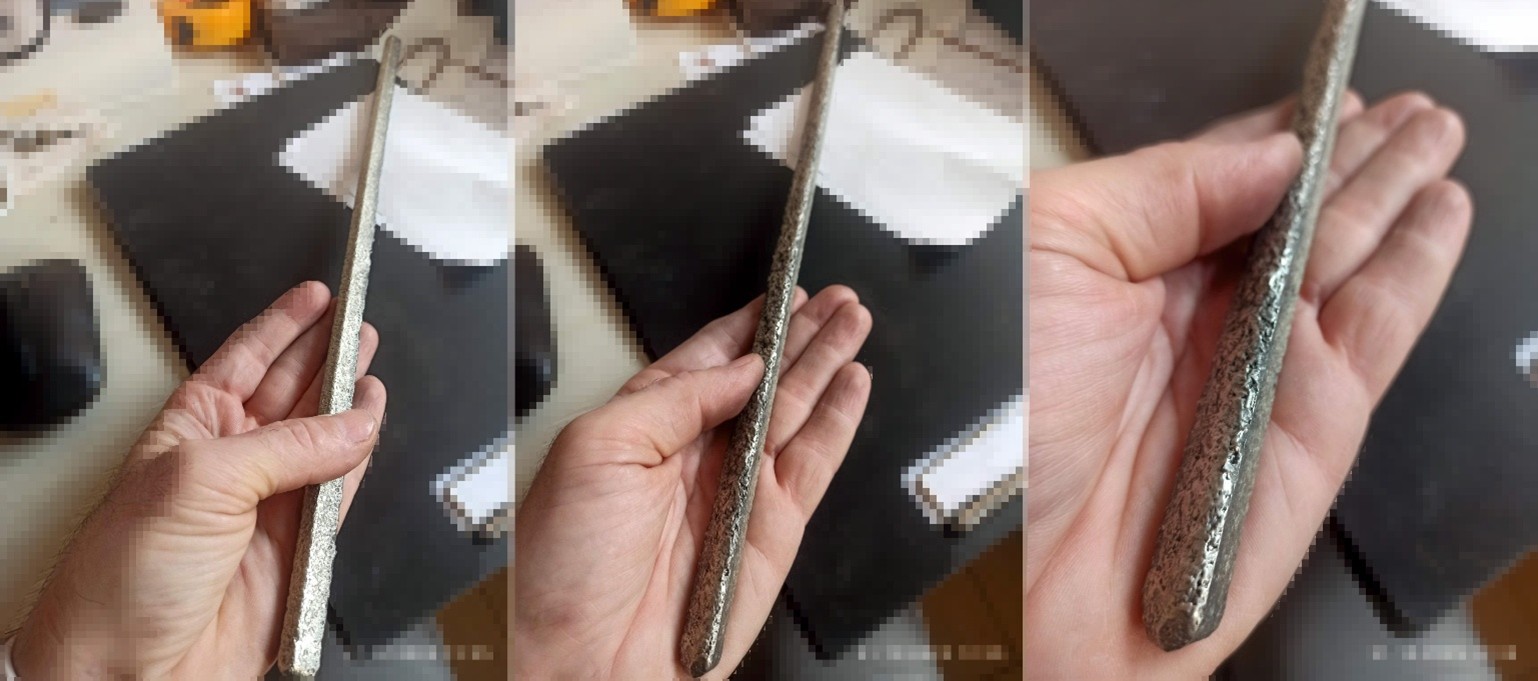
| Nickel Silver (Cu-Ni-Zn) | SilverBite | SilverBite represents TechCarbide composite hard-facing rods with WC–Co particles embedded in a Cu–Ni–Zn nickel silver matrix composed of Ni 9–12% / Cu 46–50% / Zn 38–44%. The company recommends applying SilverBite using hard-facing methods (primarily oxy-fuel gas welding) with preheating to 315–427 °C, controlling carbide overheating, and implementing slow cooling. This matrix provides a layer with pronounced cutting properties and high wear resistance, which is especially vital for remedial mills operating under combined abrasive and impact loads. |
| Nickel Bronze | BronzeGrip | BronzeGrip represents TechCarbide composite rods with tungsten carbide particles in a low-fuming nickel bronze matrix of class UNS C68000 / AWS RBCuZn-B with a matrix composition of Cu 56–60% / Ni 0.20–0.80% / Zn — balance and an approximate melting range of ~866–882 °C. Manufacturers position this matrix as one that ensures good wettability and reliable carbide retention, forming a layer where the carbides remain "exposed" and function effectively for cutting. The recommended application approach is oxy-fuel gas torch hard-facing utilizing a borax/boric acid type flux and a neutral flame. This matrix is tailored for drilling and rock formation operations, as well as milling/cutting, where a combination of pronounced cutting action and high layer wear resistance is required. |
| NiCrB / NiCrBSi (self-fluxing nickel) | ChromeFuse | ChromeFuse represents TechCarbide composite hard-facing rods with tungsten
carbide (WC) particles in a self-fluxing nickel matrix of the Ni–Cr–B–Si system. The nickel-based matrix with
chromium, boron, and silicon additions is engineered to form a dense, wear-resistant layer with
enhanced chemical resistance, making the series targeted at components subjected simultaneously to abrasives and aggressive
environments. The company recommends applying ChromeFuse via hard-facing (primarily oxy-fuel gas; if required — gas tungsten arc welding / TIG) with high-quality surface preparation, preheating according to the base metal requirements, controlling heat input and carbide overheating, as well as ensuring slow cooling without water quenching. |
| Nickel Chrome Boron (BNi-2 / AMS 4777 / Ni620) | NickelSeal | NickelSeal represents experimental TechCarbide composite rods with WC–Co particles in a
Ni–Cr–B–Si matrix. A BNi-2 nickel alloy is utilized as the matrix, featuring the ability to wet hard carbides at
high temperatures; the melting range of the matrix is ~970–1000 °C. The company recommends applying layers of this TechCarbide rod via heating with matrix fusion, controlling the process in a protected atmosphere, including surface preparation, preheating, matrix melting, and slow cooling after layer formation. This matrix delivers a composite layer with a dense metallurgical bond between the WC–Co and the matrix, enhanced heat resistance, and wear resistance under high mechanical and thermal loads, although technologically it requires higher temperatures and stricter control than low-temperature TechCarbide hard-facing rods. |
| Silicon Bronze (zinc-free) | ZincSafe | The ZincSafe (zinc-free) series consists of TechCarbide composite hard-facing rods with WC–Co particles in a silicon bronze (Cu–Si–Mn) matrix of approximate class C65500: Cu — balance / Si 2.8–3.8% / Mn 0.50–1.3% (zinc is not used for alloying; up to 1.5% Zn is permissible in the reference composition of C65500), with an estimated melting range of ~971–1027 °C. The company recommends applying Silicon Bronze via the hard-facing method (primarily oxy-fuel gas) using a boric acid flux, controlling carbide overheating, and ensuring slow cooling without water quenching; for silicon bronze in the oxy-fuel gas process, preheating is typically not recommended. This zinc-free matrix allows the use of the TechCarbide rod in scenarios where Zn-containing materials are undesirable, forming an aggressive carbide wear-resistant layer, which is particularly essential for remedial mills in combined abrasive and impact load applications. |
| Stainless steel matrix (304 SS) | InoxGuard | InoxGuard - Stainless Steel Matrix (304 SS) composite tubular hard-facing rods by TechCarbide feature a 304 stainless steel sheath (AISI 304 / UNS S30400 / EN 1.4301) filled with WC grit (sintered WC–Co or crushed cemented carbide WC–Co). During application, the sheath metal melts and forms the matrix bond that anchors the carbides in the hard-faced layer; therefore, the company recommends applying the TechCarbide rod using the hard-facing method with a controlled weld pool (primarily TIG/GTAW, or PTA / laser cladding where available) with critical control over WC particle overheating, minimizing the residence time of WC in the melt, and ensuring minimal dilution by the base metal, followed by controlled cooling. This bond delivers a combination of WC wear resistance and enhanced corrosion resistance of the layer compared to carbon/low-alloy matrices, though 304 is not optimal for environments with high chlorides (sea water, etc.). |
Selecting a TechCarbide Rod by Tungsten Carbide WC–Co Filler Type
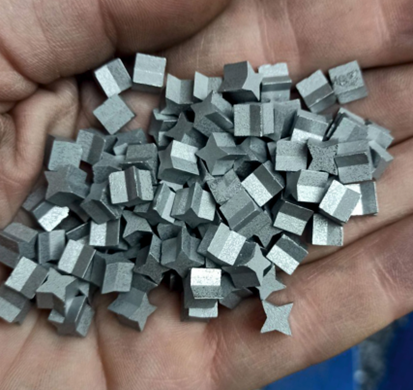
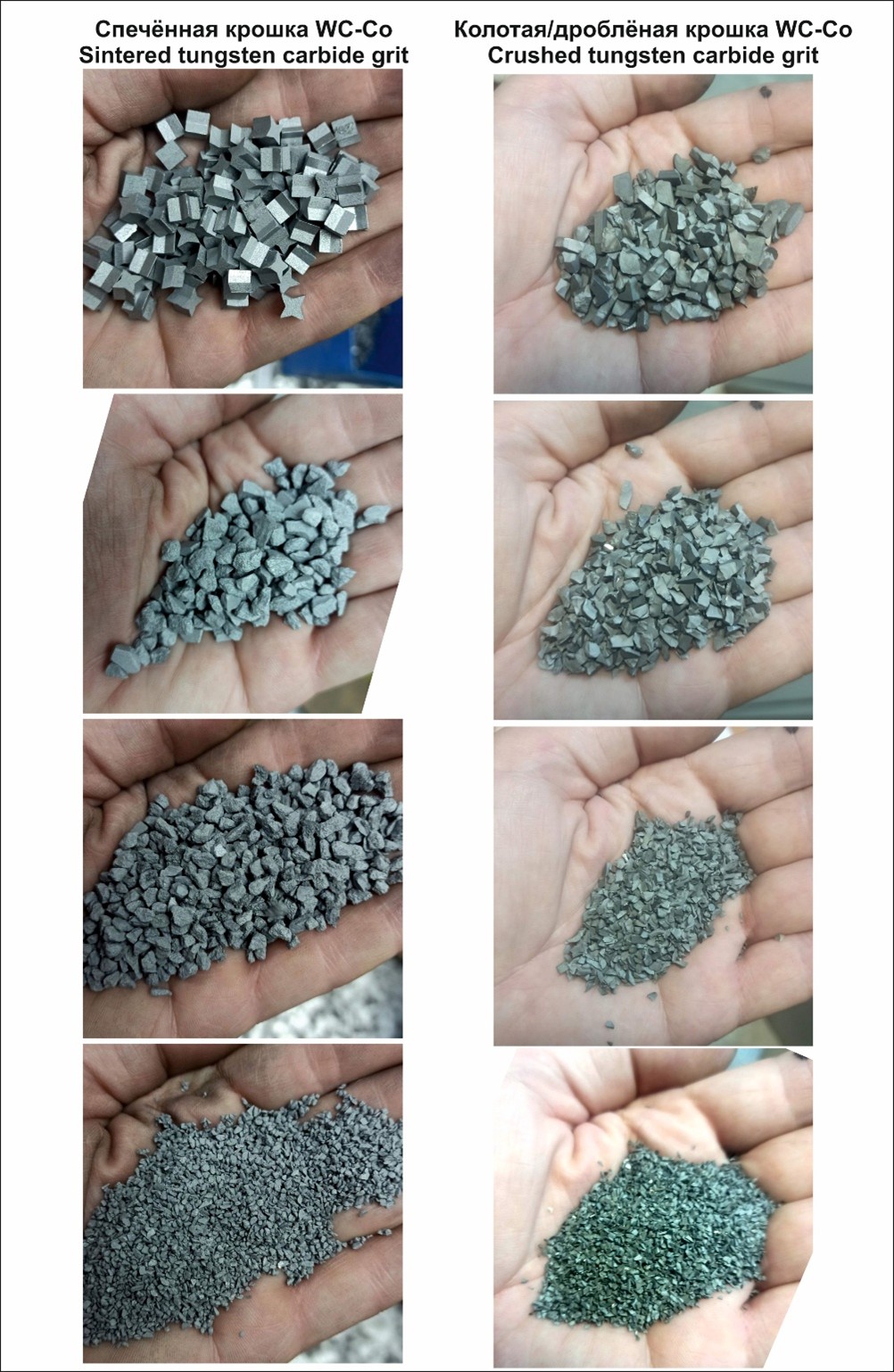
In TechCarbide hard-facing rods, we first determine the tungsten carbide WC–Co filler type, and then the cobalt composition (and, if necessary, the presence of other carbides). This is required not for "formalities," but to purposefully manage the layer's behavior: cutting/abrasion, particle retention, and service life stability.
Filler Types:
A. Grit
- S — sintered (sintered grit)
- C — crushed (crushed/fractured grit)
- Fraction (Mesh size): 1–5
B. Shaped Inserts
- CUBE — cube
- CYL — cylinder
- ST1 — "star" type 1
- ST2 — "star" type 2
- Size Group: 0–3
Cobalt Content Selection (WC–Co):
- Universal (WC 85–92%, Co 8–15%) — the baseline, "workhorse" option for most tasks. It is selected by default when predictable behavior is required without specialized demands.
- Co Modifications are applied when it is necessary to shift the property balance of the carbide filler for a specific operating mode.
- Additional Carbides (TiC/TaC, etc.) are considered as specialty options when targeted correction of filler behavior under wear conditions is needed.
| Obstruction Material / "Junk" | Operating Priority | WC–Co Filler (Shape) | WC–Co Composition (by Co) | Practical Note / Adjustment |
|---|---|---|---|---|
| Predominantly Metal (pipes, BHA elements, "iron") | Carbide retention, resistance to uneven loads/vibrations | S for uniform service life; CUBE/CYL — when stable "supporting" protrusions are needed; C — if greater cutting "aggressiveness" is required | Start with Universal; in case of chipping/loss — Co↑ (conventionally Co12+) | Metal tends to "tear out" the filler more often: if you observe loss/chipping — increase Co and/or switch from C to S/CUBE/CYL |
| Predominantly Cement Sheath | Abrasion + stable wear to prevent the tool from "glazing over" | C or ST1/ST2 for the most active profile; S — when long uniform performance across an area is required | Start with Universal; in case of rapid abrasion without chipping — Co↓ (conventionally Co10–) | For cement, "edges" (ST) or "coarse" carbides (C) are often critical; if it begins to crumble/fall out — shift back toward Co↑ |
| Abrasive Mass (mud, sand bridge, rock formation) | Abrasive wear resistance and layer stability ("sand against metal") | S (uniform service life); CYL — for constant contact zones/guide surfaces | Start with Universal; in case of prolonged abrasion without chipping — Co↓ (conventionally Co10–) | Here it usually wears down via abrasion: if there is no chipping, lowering the Co content yields better abrasive wear resistance |
| Mixture (metal + cement + junk), unpredictable regime | Universal performance without drop-offs | Basically S or C (medium fraction size for the tool); shaped inserts — only for a well-defined task: ST (edges) or CUBE/CYL (supporting points) | Start with Universal; follow up based on symptoms: loss/chipping → Co↑; rapid abrasion without chipping → Co↓ | For a mixture, control and repeatability are key: start with Universal, then fine-tune based on actual performance of the layer |
Selecting a TechCarbide Rod by Tungsten Carbide WC–Co Filler Size
After selecting the series (matrix) and filler type (grit or shaped inserts), the next practical step is size. It is the grain/insert size that determines how "coarsely" the layer operates, how quickly it forms the working cutting/abrasion profile, and how it behaves in narrow clearances and on edges. For rapid identification, We utilize a single translucent color coding system for each fraction.
WC–Co Grit Fractions (1–5)
| Fraction | Range, mm | Color (Translucent) | HEX (Example) |
|---|---|---|---|
| 1 | 7.9–6.4 | Red | #D32F2F99 |
| 2 | 6.4–4.8 | Blue | #1976D299 |
| 3 | 4.8–3.2 | Green | #388E3C99 |
| 4 | 3.2–1.6 | Yellow | #FBC02D99 |
| 5 | 1.6–1.2 | Orange | #FB8C0099 |
Boundary Rule: The limit value belongs to the next (finer) fraction: 6.4 → 2; 4.8 → 3; 3.2 → 4; 1.6 → 5.
Size Groups for Shaped Inserts (0–3)
For shaped inserts, we utilize groups 0–3 based on nominal size. The S suffix is not applied to the size — only the group number is specified.
| Group | Nominal, mm | Color (Translucent) | HEX (Example) |
|---|---|---|---|
| 0 | 9.5 | Purple | #7B1FA299 |
| 1 | 7.9 | Red | #D32F2F99 |
| 2 | 6.4 | Blue | #1976D299 |
| 3 | 4.8 | Green | #388E3C99 |
Flux in TechCarbide Hard-Facing Rods: Composition, Function, and Application Format
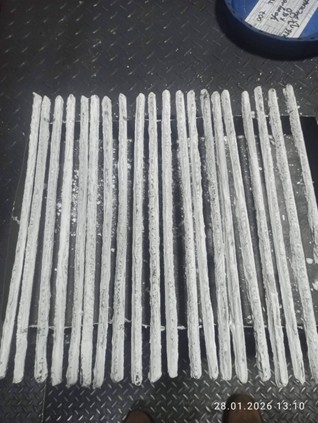
Flux in a TechCarbide hard-facing rod is a fully functional technological component without which the WC–Co tungsten carbide filler cannot realize its full properties. Its role is to ensure a clean, stable weld pool, proper wetting of the base metal, and secure anchoring of the grain within the matrix.
Composition and Matrix Alignment
In practice, boron-containing systems with activators are utilized, designed for the melting temperatures of copper-nickel, copper-zinc, or nickel matrices. A typical base includes:
- Sodium tetraborate (Na₂B₄O₇) — the core of the flux, dissolves oxides and forms a protective glass-like film;
- Boric acid (H₃BO₃) — stabilizes performance during heating and enhances cleaning;
- Fluoride activators (KBF₄, KF, NaF) — improve wetting and surface cleaning;
- Fluidity regulators (silicates, carbonates) — adjust the melting point and viscosity.
The composition is selected for a specific matrix:
- For Cu–Ni–Zn (nickel silver) — moderately active borofluoride systems;
- For bronze bonds — controlled fluidity to avoid excessive runoff;
- For nickel matrices — enhanced thermal stability and activity.
Function within the Layer
The flux ensures three critical processes:
- Surface Cleaning — removal of oxides from the base metal and the contact zone.
- Weld Pool Stabilization — formation of a uniform melt without inclusions and local overheating.
- Matrix Adhesion — uniform "clasping" of WC–Co grains without voids or weakened zones.
Flux is not a part of the final working layer: it performs a technological function and partially burns off or is removed after hard-facing. However, it is precisely its performance that determines whether the layer's service life will be predictable or if a repeated run will be necessary due to grain loss or defects.
Flux Application Format: Balancing Speed and Flexibility
In practice, two approaches are used: the flux-coated rod TechCarbide Fx or the bare TechCarbide rod with separate flux application. These are not different technologies, but different models of process management.
The flux-coated TechCarbide Fx rod features flux applied under factory conditions. This ensures stable dosing and repeatability, minimal preparatory operations, high speed in field conditions, and less dependency on the welder. At the same time, the quantity and composition of the flux are fixed, flexibility under non-standard conditions is limited, and the coating itself requires careful storage due to moisture sensitivity. This format is practical where time is the key resource and a predictable outcome is required.
The bare TechCarbide rod with separate flux involves applying flux directly prior to hard-facing. This provides the ability to adjust dosing, adapt activity to the surface condition, modify layer thickness for a specific thermal regime, and work with different matrices. Separate flux becomes a tool for technological fine-tuning: it can be increased during severe oxidation, decreased to avoid excessive running, or used to locally reinforce fluxing in a problematic zone. However, such flexibility means a higher dependency on the welder's experience, additional preparation time, and a risk of defects in case of dosing errors.
Thus, the choice of format is a choice between maximum repeatability and speed on one side, and the possibility of fine process adjustment on the other.